Showing posts with label art. Show all posts

Tuesday, May 12, 2020

, ,

"Rainbow Connection" (2020) (1979) - Kermit the Frog


In a special performance from a riverbank in the woods, Kermit the Frog sings Rainbow Connection, his Oscar-nominated hit.
The song was originally written for the frog and his banjo by Paul Williams and Kenneth Ascher for 1979’s The Muppet Movie

Watch the original here:

Swamp-dweller Kermit plucks a banjo, contemplating rainbows and “what’s on the other side”—much like Judy Garland’s Dorothy in The Wizard of Oz. But “Somewhere Over the Rainbow” was not the song’s main inspiration.
“The model we used was ‘When You Wish Upon a Star,’ which opened Disney’s Pinocchio,” Williams said. “This is Kermit’s ‘I am’ song. This song will show that Kermit has an inner life, a spiritual life…”
“The thing that is so human about the song, and spiritual at the same time, is that it honors the questions, not the answers,” Williams explained. “That moment made Kermit not the mentor, not the teacher, not the preacher. He became a seeker with the audience.”
kermit with his banjo

Tuesday, April 21, 2020

,

Art Museum for Gerbils - Pandoro & Tiramisù Gerbils


London-based couple Filippo and Marianna's self-isolation project calls to mind artist (and museum curator) Bill Scanga's At the Met, exhibited nearly 20 years ago as part of the group show Almost Warm and Fuzzy: Childhood and Contemporary Art at P.S.1 Contemporary Art Center (now known as MoMA PS1).
Scanga's installation involved hanging mini-replicas of works from the Metropolitan Museum's American collection on extremely long wires that traveled from under-ceiling picture rail to the baseboard, where a collection of art-loving taxidermied mice waited expectantly. One rested on a familiar-looking, black vinyl upholstered bench, a tiny blue shopping bag from the Met’s gift store parked near its dainty, shoeless feet.


Thursday, April 2, 2020

Sunday, March 22, 2020

Sunday, February 16, 2020

,

Recycled Paper Animal Scupltures - Chie Hitotsuyama


Using rolled strips of repurposed newspaper, cut and painstakingly placed using wood glue, Japanese artist Chie Hitotsuyama creates beautifully detailed, three-dimensional sculptures of wild animals… walruses, rabbits, sea turtles, iguanas, monkeys, dugongs, and more. Her work is inspired by the unnoticed daily perseverance of animals in nature. From Kokusai Pulp & Paper:
“I came across a wild rhinoceros at a national park in Zambia, Africa, which I visited at the request of one NGO in 2007 when I was working as an illustrator,” recalls Ms. Hitotsuyama. “The rhino was injured because of human egos. I heard from the park ranger who guided me that rhinos have been killed brutally by poachers who want their horns. From my wish to share this reality with many more people, I created my first work, a rhinoceros
After that, I became strongly aware of what life is all about, what it means to live,” explains Ms. Hitotsuyama. “Animals that live in nature are equal to us in the sense that we live together on this planet. Sometimes they sleep. Sometimes they eat. They are living ordinary everyday lives just like us. I would like keep insisting on reality and producing my life-sized work as much as possible in order to convey their lives.”
hitotsuyama-fox
hitotsuyama-rabbit
hitotsuyama-monkey
hitotsuyama-iguana
hitotsuyama-rolling-paper
Hitotsuyama’s paper work is multi-generational: Her Fuji-based studio is located in the old warehouse of a paper strip manufacturing plant that was once operated by her family.

Monday, December 30, 2019

, , ,

Evelyn Lambart Shorts


The Lion and the Mouse is a classic fable that highlights how huge contributions can come from unexpected places, that a kindness is never wasted, and that even when you’re the king of the forest, you can be in need of help.
This 1976 version of the story was created by National Film Board technical director and ‘First Lady of Canadian Animation’ Evelyn Lambart in her signature style: “…paper cutouts transferred to lithograph plate which she would then paint and animate.”


In this short animation by Evelyn Lambart, a greedy little blue jay carries away whatever his beak can grasp. Berries, birds’ eggs (nests and all), and even the sun in the sky go into his secret cache. Nothing is safe from his consuming avarice. But, as in Lambart’s film Fine Feathers, there is a moral tucked away. The blue jay learns a lesson about the importance of sharing, and he and his friends are all the merrier for it.
Canadian animator Evelyn Lambart is celebrated for her trailblazing contributions to animation and her beautifully illustrated work with cut outs of construction paper and painted zinc. In 1942, she was the first woman animator to join the National Film Board of Canada where she worked for more than 25 years. The Hoarder, shown above, was created in 1969.
the hoarder and the sun
running away


Fine Feathers (1968)


From Evelyn Lambart, renowned Canadian animator and technical director with the National Film Board of Canada, this is Fine Feathers, a 1968 cut paper animation about two rival birds that trade their plumage for green cedar and red oak leaves. Of her beautifully illustrated animation work, Lambart said:
“I loved to do the whole job myself, you know, figure out what you need to tell your story, and then to make it myself, to design the character and paint it and draw it and then to sit under the camera and move it. I did all the shooting myself too. I used to hope I was making films that were simple enough for children but still interesting to adults.”
fine feathers - leaves
the wind

Monday, November 11, 2019

,

Halloween at ServiceNow


Our team jumped into the Experience Organization costume contest for Halloween.  We are all dressed up as avatars, one of our web components in the Now Design System (is that what we're called now?) Library.  We also feature presence icons on the bottom right of the plates.  I am front and center, lol.

We made the front page of the Q-3 EO Newsletter.  :)

Friday, September 13, 2019

, ,

Hollow Mask Illusion - Royal Institution


How do we perceive faces? With some balloons, newspaper, some paste for paper mâché, and paints, you can create a hollow mask that appears to follow you as you move back and forth around the room. Rachel and her children Eva and Daniel investigate the illusion in this video from The Royal Institution‘s ExpeRimental series, a resource that can help parents set up fun, easy, and cheap science experiments at home.
This classic illusion can baffle brains of all ages. Making the masks can help us explore why it works (or doesn’t work), and why our brains can be so easily tricked. Here’s the Einstein mask in video form:


This series of ExpeRimental is supported by The British Psychological Society. To avoid any spoilers/test conclusions, pause the video at 3m50s. Find the full instruction sheet here (pdf).

Monday, July 8, 2019

DIY Natural Inks


A little bit about light and pigments:
A pigment is what gives a color its color. It is a material that changes the color of reflected or transmitted light of an object. Light appears white, but it is made up of all the colors added together. We see those colors separated out in a rainbow or a prism. These colors are represented in the visible spectrum of light- the light we can see with our eyes. Objects reflect some colors and absorb others. The color red is not actually “in” an apple. The apple is reflecting the red light and absorbing all the rest. We see different amounts of each color reflected/absorbed to produce the final color we see.
Light moves in waves and each wave has a length (wavelength) that is shown in the chart. We measure these wavelengths in nanometers (nm). Each color of light has a wavelength measured this way so when you look at a chart of the visible spectrum of light you will normally also see “nm” & “wavelength” on it.


How the spectrum of light can help us see the difference in ink we make at home vs. ink we buy at the store:
Most of the inks & paints we buy at the store are modern pigments made by using inorganic (not made from living matter) ingredients. Natural pigments- those made out of organic or living ingredients- have been made since ancient times. The inks were made out of things people could find around them in nature. Some colors were rare since the ingredients used were from far away, this can also make them expensive. In the 1800s the Industrial Revolution happened & we started to make paint differently with inorganic ingredients. We could refine oil- break it down until it can be used for fuel- and use the products made from the process in our paints to bind the pigments together differently. We also had scientific advancements in chemistry that allowed us to make pigments instead of just finding them in nature. This dramatically increased the variety of color pigments we have now.
Why do modern paints look “richer” or “more specific” than natural paints?
See the two different paints in Photo 4. One is a natural paint and one is a synthetic (manmade) paint. You can see on the graph of light that they reflect different color combinations. Modern paints are reflected in a very narrow space in the spectrum. Cadmium Red is only really reflected in the red spectrum and very highly. Natural paints are reflected across the entire spectrum with a concentration in one area Red Ochre is reflected in all colors, more so in red spectrum but not significantly more than other colors. More red, and only red is reflected back to our eyes by the modern paint. That’s why it looks more like a true red. Red, but also a lot of other colors as well are reflected back to our eyes by the natural paint. That’s why it looks like a dull or brown-ish red.


Supplies:


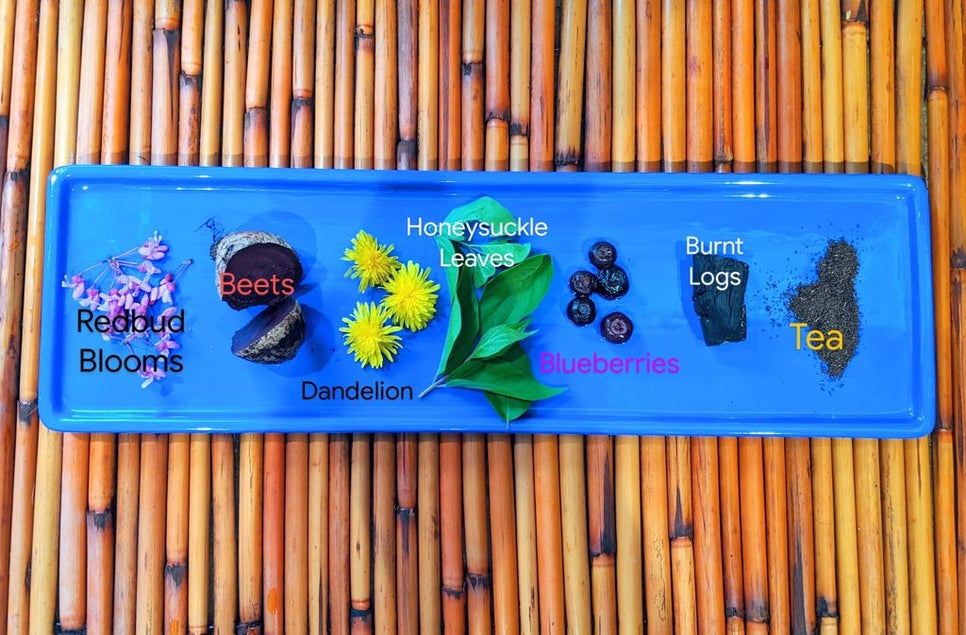
  • Pigment materials- flower petals, leaves, tea, fruits & vegetables, spices & charcoal/soot
  • White vinegar
  • Salt
  • Hot water
  • Scissors
  • Bowl
  • Spoon
  • Coffee Filter
  • Containers for your ink
  • Paper
  • Paint brush

Step 1: Get Your Natural Materials Ready

In order to make the inks with your natural materials ready. You’ll need to cut them up or crush them. You can cut them with scissors and/or crush them with the back of a spoon. If you’re making more than one color ink make sure you wash your scissors or spoon in between so you don’t mix colors. Add each natural material to a separate container.


Step 2: Mix Your Natural Inks

You’ll need hot water, almost boiling, to add to your natural materials. Our natural materials measured to about 1 TBS each. We added in 1/4 cup of water- you can add more depending on how much natural materials you have. After you do that you need to add the vinegar (1/2 tsp per ¼ cup of water) & salt (1 pinch per container). Vinegar has been used in inks for quite a while. It’s what’s called a “mordant” or “fixative”. It helps the dye “bind”, “set”, or attach onto paper of fabric. The salt will help preserve the ink so that it lasts longer. Now let it sit overnight.
*Optional, come back in an hour to check on your ink. If it seems to light you can add more materials or other natural ingredients. Remember it”s not going to look like store-bought ink, it will be fainter in color. We added grass clippings to the green ink & raspberries in the pink ink. Look at our final ink picture to see what it will look like.


Step 3: Finish Your Natural Ink


When you come back you should see that the water is tinted the color of your natural materials. Now you need to sift out the particles so it’s all liquid. Use a coffee filter stretched over your final ink container to catch the solids.