A new design that hearkens to Theo Jansen‘s original kinetic structures from the early 1990s, the PVC tube-constructed Uminami Strandbeest doesn’t get sand into its joints and requires no lubrication to move smoothly. Watch as it speeds across the sand on a beach, presumably not far from Ypenburg in The Netherlands where Jansen lives and works.
From the Smithsonian Magazine: The creation of good cheese involves a complex dance between milk and bacteria. In a quite literal sense, playing the right tune while this dance unfolds changes the final product’s taste, a new study shows. Denis Balibouse and Cecile Mantovani at Reuters report that hip-hop, for example, gave the cheese an especially funky flavor, while cheese that rocked out to Led Zeppelin or relaxed with Mozart had milder zests. Read the rest of the article HERE.
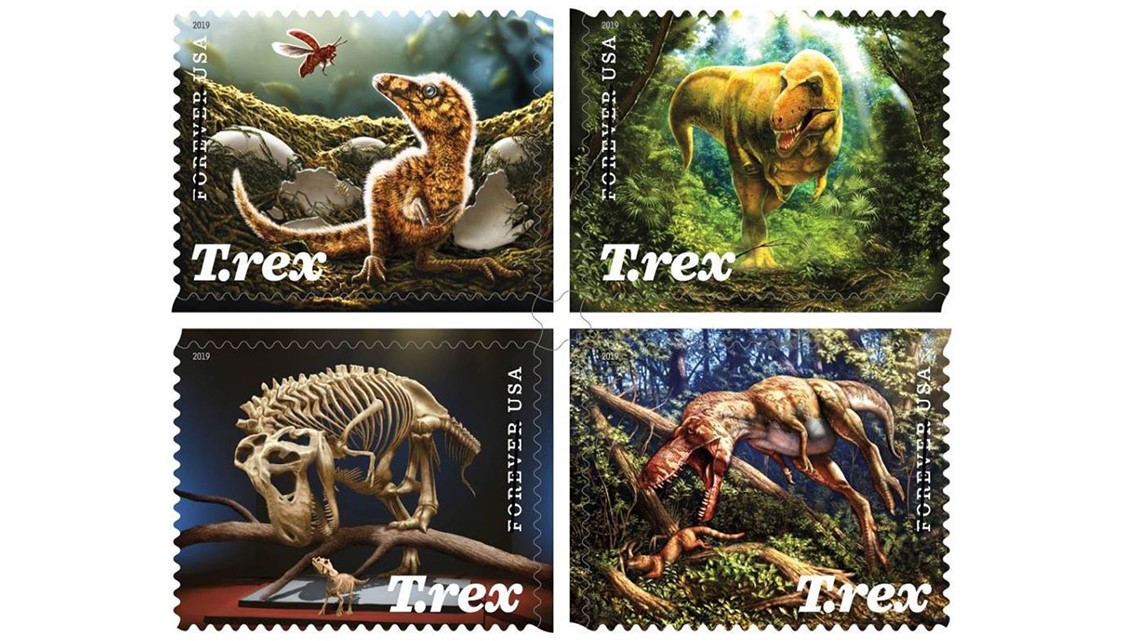
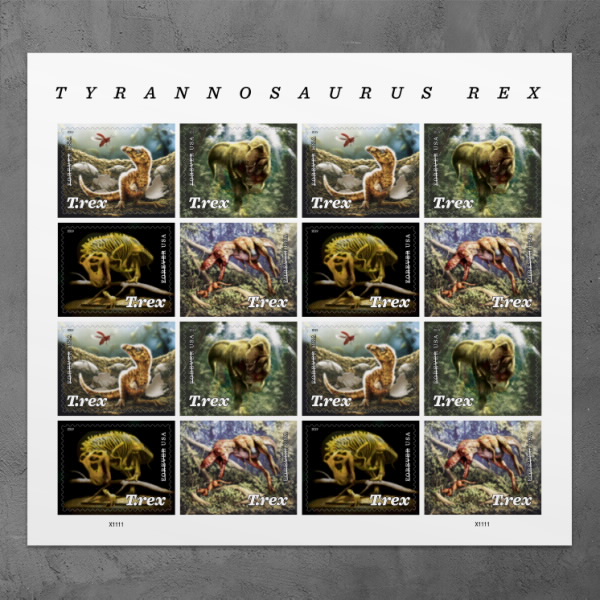
There will be a total of 16 stamps available, the U.S. Postal Service said.
"'The “Nation’s T. rex,' the young adult depicted on two of the stamps, was discovered on federal land in Montana and is one of the most studied and important specimens ever found," postal service officials said in a release earlier this week.
Ocean Sole turns millions of discarded flip-flops into art pieces and other useful products in an effort to promote ocean conservation and reuse beach pollution from along the East African coast. See how these Kenyan flip flop artists collect, wash, sort, cut, glue, carve, and sand this waste material into colorful lions, elephants, whales, giraffes, pandas, dinosaurs and other animals—and how smaller pieces are used for beads and kids’ playground padding—in this BBC video.
After the ball drops in Times Square on New Year’s Eve, the crowd cheers, couples kiss, confetti flies and the song you hear is “Auld Lang Syne.” For Americans this song is associated with another year passing, but it means something else entirely in other cultures. Since the Scottish poet Robert Burns first published the words to the song in the 18th century, the melody has been adapted as a soccer ballad in the Netherlands, a graduation song in Japan, and more.
So, how did Auld Lang Syne, a Scottish folk tune, become America’s go-to song for New Year’s Eve celebrations? It’s all for old time’s sake and remembering friends. Also: Guy Lombardo. Vox explores the history and usage of this song in The New Year’s Eve song, explained.
The ocean sunfish or common mola (Mola mola) is the heaviest known bony fish in the world. Adults typically weigh between 247 and 1,000 kg (545–2,205 lb). The species is native to tropical and temperate waters around the globe. It resembles a fish head with a tail, and its main body is flattened laterally. Sunfish can be as tall as they are long when their dorsal and ventral fins are extended…
Many of the sunfish’s various names allude to its flattened shape. Its specific name, mola, is Latin for “millstone”, which the fish resembles because of its gray color, rough texture, and rounded body. Its common English name, sunfish, refers to the animal’s habit of sunbathing at the surface of the water.
Geographer turned Software Engineer, looking to shape the invisible systems that guide our world. Professionally interested in mapping, data visualization, values-based programming, and STEAM evangelism. Personally interested in crochet, knitting, textiles, and archery.


/https://public-media.si-cdn.com/filer/75/87/75870ba2-7a45-4613-9dc4-73d3edf7d5dc/hip-hop_cheese.jpg)